Continuing my Philadelphia museum review, the National Constitution Center was the first one I visited during my last trip. I had arrangements with Brian Kirsch, who gave me a wonderful tour.
We started out with their tactile exhibit, specifically made for blind and visually impaired people, but this is something that they also show to other visitors.
Before the Constitution Center was built, they had to do a major excavation to protect and preserve objects from the previous centuries.
Though they have tens of thousands of objects, the difficulty with the tactile tour of the originals would be that they may not be able to withstand handling by an infinite number of people. Therefore, they have 3D scanned some of the objects, 3D printed it, and painted them similar to the original color. In some instances it almost felt like touching the original.
I was able to hold buttons, a pipe, or pieces of a shattered plate. There were other replicas as well, for example a shoe buckle which was made of real metal, I was not aware how people secured their shoes 250 years ago.
After reviewing the replicas, we moved on to the Signers’ Hall, which I can say was one of the most interesting things I have been through recently. I wrote about the aspect of faces in another post as well.
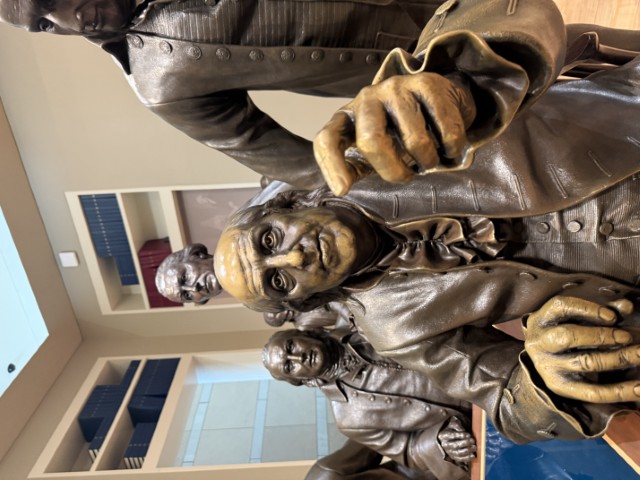
In one hall, there are 42 live size bronze statues of people who either signed the constitution, or decided not to but were there at the same time. It is set up just like it could have been in September 1787. My first question was, since there was no videos or photography those days, how did they know what people looked like. The answer varies based on each individual. There are many paintings and drawings of some people like Benjamin Franklin or George Washington, thus some people were pretty obvious. For others, they had to do thorough research, reading contemporary documents and putting pieces together as much as it was possible, representing the people as truthfully as they could. The rest was a bit of a guess for any information they had to fill in.
There was also a touch table, made completely accessible where the visitors could learn about all the people who were represented. For visually impaired people there is the option to plug in a regular headphone where the voice system gets activated and on a simple panel using arrows people can read all the information using audio. There is a way to filter the people according to many criteria, and an extensive amount of information is available. My guess is that one could spend hours reading through all the information.
As a blind person, in general, one can spend hours only in that hall. So much so that I actually returned during the last day of my trip to spend more time understanding the statues.
It is an amazing exhibit, one of the most accessible ones I have attended recently, I would highly recommend it to any visually impaired people, just make sure you have enough time. I am also adding it to the list of tactile museums.
Social Media
Communication
Bookmarking
Developer
Entertainment
Academic
Finance
Lifestyle
Tactile exhibits, accessibility audits, staff training. That’s my work. Let’s talk about yours.