Press "Enter" to skip to content

Tag: 3D

Blind people, faces, and the Signers’ Hall

Showing faces to blind people has been a challenge I have been trying to research and resolve for many years. When a face is transferred into a 2D or a 3D form and features are made so that the are enjoyable through a tactile experience, a lot is lost that is still available when looking at a live human, or a photo.

While there are many tactile representations of people, there is much less information about how recognizable those pictures, statues or 3D replicas are.

1 Comment

The Museum of the American Revolution in Philadelphia

I just returned from Philadelphia where I had an opportunity to attend an amazing tactile tour at the Museum of American Revolution. This exhibit overall talks to anyone, anywhere from kids who just hear about the revolution for the first time, or someone who is involved with US history.

We toured the museum with the team from the Clovernook Center who did much of the tactile objects for the museum. Our tour was led by Meg Bowersox, but a self-guided tour is also available, more about it later.

Leave a Comment

Accessible tactile 3D printed restroom maps for blind visitors

If you are blind, when you visit a restroom by default you will end up touching many more things than sighted people to find the same facilities. Wouldn’t it be great to minimize contact with things you wouldn’t need to touch in the first place?

This is why I invented the accessible tactile 3D printed restroom maps.

A tactile restroom map is a 3D-printed miniature replica of a restroom’s layout, mounted beside the ADA sign, that blind visitors can feel before entering.

When a blind person visits a restroom, before they enter they can quickly examine a map of the exact layout of the restroom so they can go exactly where they want to without having to explore and accidentally touch more than necessary.

accessible tactile restroom map including a sink, toilets, urinals, paper holders, hand dryer and doors.

4 Comments

When 3D printing is preferrable to 2D tactile graphics

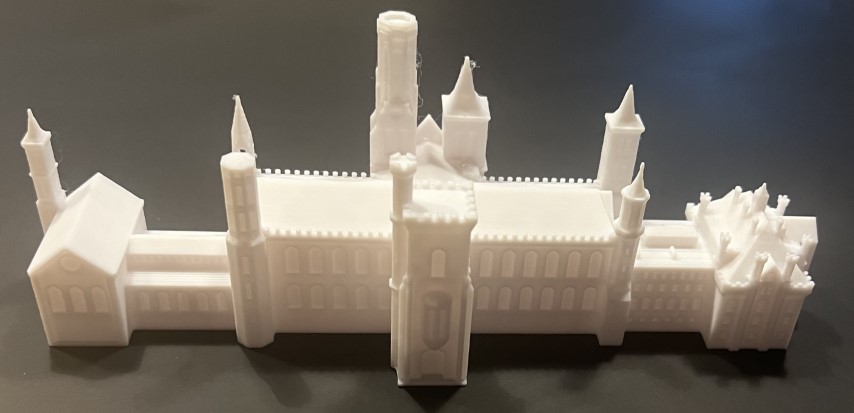
When supplying visual materials with braille books for the most part the use of tactile graphics is sufficient. However, there are many instances when providing 3D printed objects can enhance the understanding of the material. Even the Tactile Graphics Guidelines Mention 3-dimensional objects in the first sentence of the document: “Tactile graphics, in combination with 3-dimensional models, need to be introduced early in the process of learning braille.” Throughout this document 3-dimensional models are mentioned many times.

However, when it comes to practical implementation, rare are the books which are supplied with 3D objects. When I talked with many teachers of the visually impaired and with braille transcribers, their response was that while they are aware of the possibility of using 3D objects, but there is very little information on how to source these and what it really takes to get it produced.

In this post I will talk about what makes a good candidate for 3D printing and what is better supplied in 2D, or not at all. I will also look at the production process to help make the decision if 3D representation is indeed the right option for a particular object.

Leave a Comment

Braille Production Services announcement

Making Accessibility Tangible: Our New
Braille Production Services announcement
Launch May 1, 2025

At Even Grounds, accessibility isn’t an add-on — it’s at the heart of what we do.
That’s why we are proud to announce the launch of our Braille Production Services, officially available starting May 1, 2025.

What differentiates us from other similar companies is that we are leveraging our 3D design and production services, offering 2D tactile design to create exactly what makes life most accessible to your
clients.

Leave a Comment

Tactile Learning: The Role of 3D Printed Objects in Education for the Blind

From textbooks and graphical illustrations to screens, it is clear that visual aids have always held massive importance in the sphere of education. It is much more difficult for students who are visually impaired to access the same level of information as their counterparts. Learning tools such as embossed graphics or Braille materials provide some assistance. Still, they often lack the specific required details and versatility that would be able to ensure a comprehensive understanding of the subject.

Leave a Comment

Tactile Maps and Braille: Balancing Accessibility and Practicality

Creating accessible maps for individuals with visual impairments is a complex process. When designing tactile maps, we need to carefully consider how to best integrate braille to convey information effectively without sacrificing practicality and efficiency. This post explores the challenges and solutions involved in using braille on tactile maps, drawing from our design experience.

Leave a Comment

Exploring the World with Touch Mapper: 3D Printing Tactile Maps for the Visually Impaired

I am always searching for innovative solutions to enhance the independence of visually impaired individuals. One such solution that has captured my attention many years ago was Touch Mapper, a service that allows the printing of local maps based on addresses. These tactile maps, designed for blind and visually impaired people, show roads, buildings, and bodies of water, with data sourced from OpenStreetMap. With my new 3D printer, it was finally time to put it to a test.

2 Comments