Press "Enter" to skip to content

Category: Blindness

Running with a guide dog

I will never forget how much more freedom I experienced all of a sudden when I got my guide dog, Baldwin from guiding eyes for the Blind. That was approximately the time when Guiding Eyes started to train running guides. This means that a blind or visually impaired person can take up running as a sport and do it independently with a guide dog. The white cane is not for running, it is simply dangerous.

One could ask, why not just run with a regular guide dog? After all dogs enjoy running. This is why it is not possible: a guide dog by default is trained to recognize and avoid obstacles at a walking speed. When one would run with a guide dog, practically it would ask the dog to do something she has never been trained to do. It would be confusing for the dog and dangerous for the blind person. During the training program, Guiding Eyes does ask dog handlers not to run with their dogs while guiding, unless the dog has been specifically trained for that. By default, Guiding Eyes does not train running guides, but anybody can request one.

Leave a Comment

Miniature 3d printed buildings for blind people

Miniature 3d buildings for blind people

It has always fascinated me how to explain what a building looks like to a blind person. But as they say that a picture is worth a thousand words, a tactile experience is also definitely more accurate than a thousand words. For that matter, the two together is the best approach.

Since I couldn’t find a resource where I could get the models of 3d buildings, I created my own.

Smithsonian Castle

2 Comments

The Country of the Blind by Andrew Leland, book review

Andrew Leland, a journalist, audio producer, editor and professor, in “The Country of the Blind” writes about how he gradually lost his vision due to retinitis pigmentosa. But this book is much more than his story. One can view it as a history book about blindness and blind people.

Andrew Leland takes the reader through how he practically lost his eye sight starting in fifth grade when he noticed that he didn’t see as well as his friends to today, when his field of vision is so narrow that he practically needs to do things the blind way. As he narrates his story, in each chapter he looks at different issues related to blindness and provides a very well-researched overview of all topics. After reading the book, I felt that I knew the facts, but now I understand the stories and the reasons behind them.

Leave a Comment

What Makes an Accessible Environment?

I often hear the argument that making something accessible for blind people is not worth it, because there aren’t many blind people using it. My argument usually is that if it was accessible, you would have more blind people taking advantage of it. It is even more difficult when we don’t just make something accessible by fulfilling the minimum necessary requirement, but making the environment truly inclusive to blind people, where they don’t only get information, but they can enjoy something just like sighted people do. Often, this can cost much more time and money.

In this article I would like to show you why inclusion is worth it, and how it can benefit many other clients, not only blind people. I am sure you have heard the arguments that accessibility is the law and it is our social and moral responsibility. This is true, but I would like to show you that it actually makes business sense.

Leave a Comment
First Blind Man to Complete Race Across America

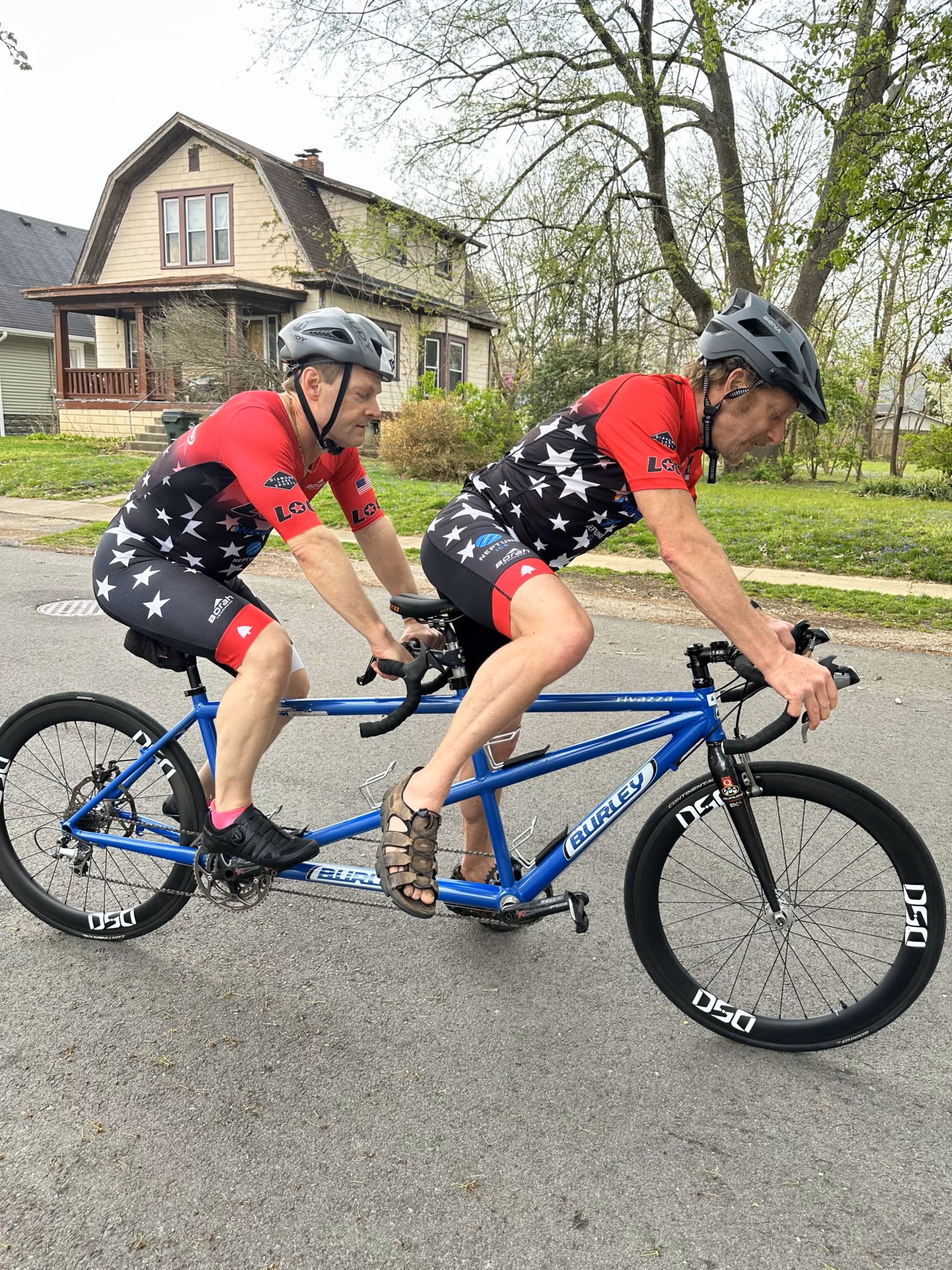
Dave Wilkinson, a blind 30-time marathon runner and Ironman, is planning nothing less in 2024 but to join the Race Across America bicycle race event. He will ride on a tandem bike with Jim Trout who has done this race several times before. They will ride 3000 miles in 12 days, across 12 states.

Dave and his tandem captain jim riding on a road

I have known of Dave over the years, and he was famous about testing the limits of what people can do, blind or sighted. But after a car crash in 2017, he needed to rethink his life and recover physically and mentally. And his way to cope was to do something even bigger, this is how he started training for Ironman and now for the Race Across America.

Dave explained to me that in his view, blindness should not hold him back from things which are traditionally thought of something that blind people are not active in. And this alone, if made him a high achiever that would already be impressive. But he has a much bigger vision in mind. He wants to provide motivation to other blind people to not be stuck inside the conventional ways. His dream is that there will be people who will do even better.

But of course there is much more to it. It is not just the courage to do it without vision. Many sports will have to be adopted to the situation, and preparation will also have its challenges. This is what makes it even more difficult, but not at all less impossible for blind people.

Leave a Comment

I Almost Lost My Friend to a Preventable Accident

The other day my friend was walking home from work using his white cane. All of a sudden he stepped into a hole, dropped 8 feet, and submerged into mud and water covering him all the way. It was the middle of the winter, the water was about 40 degrees Fahrenheit. He survived, due to nothing more than luck, when he touched a thick tube on which he could pull himself out of the freezing water. People saw the accident on the street and called the fire department, and they rescued him in half an hour.

Now you may wonder, how did it happen if he used his cane properly? Probably, he was. He was walking on a sidewalk where he had walked each day for years. He wouldn’t have thought to slow down and check for life-threatening hazards. But it was even worse. The hole was in front of a retirement home, also near a local school serving kids with special needs.

1 Comment

How to Introduce Yourself in a Meeting

Introduction

Over the last few years, you may have noticed that many meetings and conference presentations start by people describing themselves. The idea is to make the meeting as inclusive for visually impaired people as possible. But is it for visually impaired people only? Does it make a meeting more inclusive? Is it mandatory? There are many more questions for which there are no guidelines, and often gets awkward to ask. I’ll try to answer some of these questions.

2 Comments

Trip report to Scotland with a guide dog

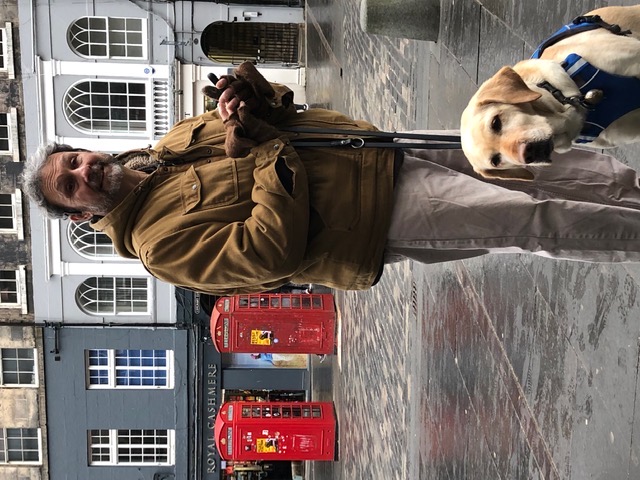
I recently read a post on a mailing list from Eric Caron, who explained the difficulties of traveling with a guide dog to Scotland. He wrote about the days of travel arrangements, paperwork, and expenses. I asked Eric if he would be willing to share his story with you. I have to say I had my fair share of difficulties to arrange trips with Baldwin, but nothing like Eric had to go through.

Eric lives in Brattleboro VT near Massachusetts and New Hampshire.  This is about a 2 hour drive from Boston.  He lives there with his wife Heidi, current guide dog Becky, retired guide Ryan, an African Grey Parrot and a Tuxedo cat.

Eric with his guide dog Becky

Leave a Comment

Blindfolds Are Not the Same as Being Blind

Often when discussing the experience of being blind, I find that different simulations are implemented to explain what it feels to be blind. Probably the most common is to put on a blindfold. While such exercises can have many different values, the only thing they don’t simulate is what it means to be blind. However, such activities do have value, they should just be used for what they are worth. In this article, I will show a few ideas and discuss how they can be useful and also what they don’t add to understanding blindness.

Leave a Comment