Most people view sports and athletics as a showcase of one’s strength against opponents, skills, and positional tactics. But to add diversity to this view, consider it from the perspective of an athlete with visually impairment. The usage of blindfolds by athletes is an intriguing and frequently misinterpreted component of adaptive sports. An interesting fact is that athletes participating in goalball and blind football wear blindfolds to ensure fairness. This makes the game more accessible where players with visibility or visual impairment both become the same.
Leave a CommentCategory: Blindness
Today is the birthday of Louis Braille, and in 2024 we also remembered that it has been 200 years that he invented the writing system…
Leave a CommentSports are all about working together, sharing power, and standing together. It transcends language and culture to bring people of all kinds. To most individuals who have blindness or visual impairment, goalball is more than just a sport. This unique sport is created for athletes who have disabilities and is a perfect example of the adaptability of sports. It helps foster confidence among the athletes, enhance communication skills, and improve spatial awareness.
This article looks into goalball’s history, rules, techniques, and influence on its players, as well as explains its role in the efforts toward inclusion.
Leave a CommentRecently I wrote about how my new building project helped me understand architecture so much better. But last week, when I attended the annual convention of the Souvenir Building Collectors Society, it took my appreciation to a new level.
Leave a CommentPeople at the Paralympics compete in 10 different categories, depending on their disability. Eight of the categories are physical disabilities, one is visual impairment, and one is intellectual disabilities. Depending on the individual sports, people with only certain disabilities can compete. This post will only contain resources related to blind and visually impaired people following the theme of the blog, but I would recommend getting to know the other sports as well. This topic has been covered in so many ways, so instead of creating yet another basic overview, it is intended to be more of a resource list for starters.
Leave a CommentFor years I wanted to attend an invisible dinner, also called dinner in the dark, but either there wasn’t one nearby or I didn’t have time. But now I came across one in Kaposvár, which is in southwestern Hungary, right where one of my best friends lives. I thought I’d ask if he would like to have dinner and tell me all about his experience. I’ve been to one of these dinners before and read a lot about it, but I was curious about it from the perspective of sighted people. It turns out that my friend János has been to this event several times in the past, and he can tell me enough about it so that we can write this interview without participating. János is completely blind, but he talked so much with the participants so he had the answer for all my questions. So I asked him to tell me about his experience.
Leave a CommentLearning languages alone changed what I could get out of travel as a blind person. Being able to have conversations in another language, or knowing a few words in the local language truly changed my experience. Often, when sighted people can point at things, I am restricted to speaking. But it wasn’t without challenges. Even today when technology comes to the rescue, there still are challenges a blind person may have to face when learning a new language. But just like in so many cases, it doesn’t have to be that way. In a few instances the lack of vision can be a limitation, but in most it is the lack of accessibility.
But let me start with a personal story. When I studied at the Overbrook International Program in Philadelphia when I was sixteen, we had a chance to learn Japanese for a year.
Leave a CommentI will never forget how much more freedom I experienced all of a sudden when I got my guide dog, Baldwin from guiding eyes for the Blind. That was approximately the time when Guiding Eyes started to train running guides. This means that a blind or visually impaired person can take up running as a sport and do it independently with a guide dog. The white cane is not for running, it is simply dangerous.
One could ask, why not just run with a regular guide dog? After all dogs enjoy running. This is why it is not possible: a guide dog by default is trained to recognize and avoid obstacles at a walking speed. When one would run with a guide dog, practically it would ask the dog to do something she has never been trained to do. It would be confusing for the dog and dangerous for the blind person. During the training program, Guiding Eyes does ask dog handlers not to run with their dogs while guiding, unless the dog has been specifically trained for that. By default, Guiding Eyes does not train running guides, but anybody can request one.
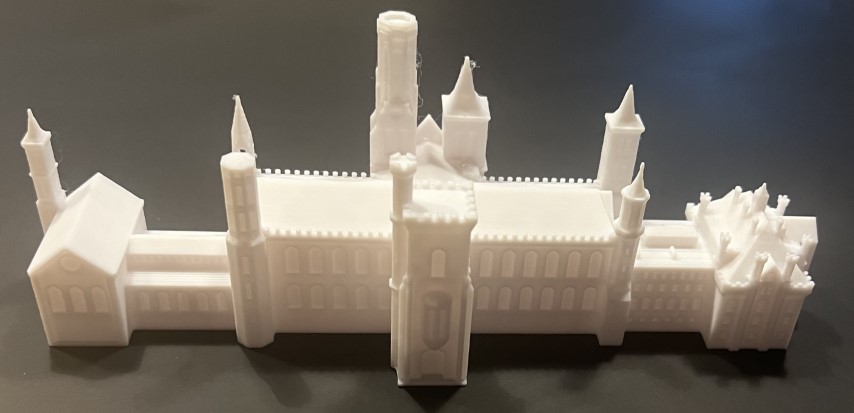
Leave a CommentMiniature 3d buildings for blind people
It has always fascinated me how to explain what a building looks like to a blind person. But as they say that a picture is worth a thousand words, a tactile experience is also definitely more accurate than a thousand words. For that matter, the two together is the best approach.
Since I couldn’t find a resource where I could get the models of 3d buildings, I created my own.
Andrew Leland, a journalist, audio producer, editor and professor, in “The Country of the Blind” writes about how he gradually lost his vision due to retinitis pigmentosa. But this book is much more than his story. One can view it as a history book about blindness and blind people.
Andrew Leland takes the reader through how he practically lost his eye sight starting in fifth grade when he noticed that he didn’t see as well as his friends to today, when his field of vision is so narrow that he practically needs to do things the blind way. As he narrates his story, in each chapter he looks at different issues related to blindness and provides a very well-researched overview of all topics. After reading the book, I felt that I knew the facts, but now I understand the stories and the reasons behind them.
Leave a Comment