Press "Enter" to skip to content

Author: Tom

I have been working in accessibility for the last 25 years. I have helped government agencies, corporations and non-profit organizations to become accessible. Over the years I taught over 20000 people about accessibility.

Difference Between the Accessibility Page and the Accessibility Statement

Introduction

There is often much confusion about how to write an accessibility statement or how is it different from your organization’s accessibility page. While there aren’t any rules set in stone, and ultimately you need to create these documents to serve your organization’s needs, generally there is room for both. They each serve a different purpose. In this article I will show you how to approach the two documents.

1 Comment

Designing an inclusive and accessible alarm clock

Let’s play a design game. The task is to come up with the most accessible, most inclusive alarm clock.

I used to give this task to my classes when I was teaching at IBM, and we had the most thought provoking conversations.

There are no good or bad ideas here. But consider that the more inclusive you make it, the more features you add, the more expensive it will get, at some point it will be unreasonable. But the more you compromise on features, the less people will be able to use it.

Let me set one more rule here, it is a standalone clock. Anything it can do it is part of the clock you design. Otherwise, it would be easy to say that you will just connect to it using your phone and an app, which probably would be your most inclusive solution.

Leave a Comment

Miniature 3d printed buildings for blind people

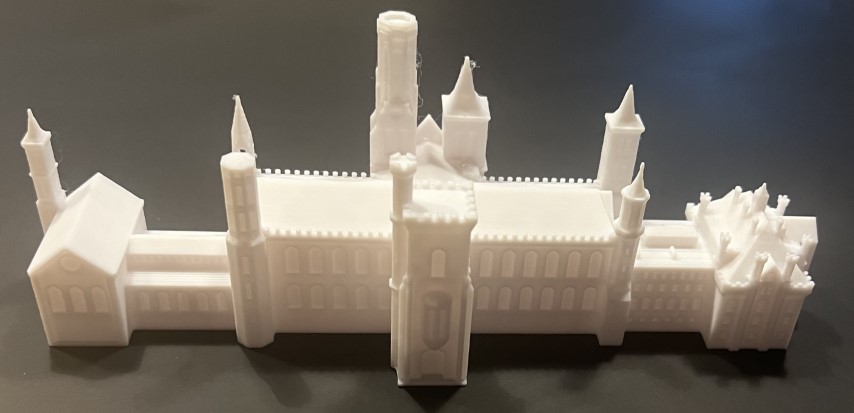
Miniature 3d buildings for blind people

It has always fascinated me how to explain what a building looks like to a blind person. But as they say that a picture is worth a thousand words, a tactile experience is also definitely more accurate than a thousand words. For that matter, the two together is the best approach.

Since I couldn’t find a resource where I could get the models of 3d buildings, I created my own.

Smithsonian Castle

2 Comments

The Country of the Blind by Andrew Leland, book review

Andrew Leland, a journalist, audio producer, editor and professor, in “The Country of the Blind” writes about how he gradually lost his vision due to retinitis pigmentosa. But this book is much more than his story. One can view it as a history book about blindness and blind people.

Andrew Leland takes the reader through how he practically lost his eye sight starting in fifth grade when he noticed that he didn’t see as well as his friends to today, when his field of vision is so narrow that he practically needs to do things the blind way. As he narrates his story, in each chapter he looks at different issues related to blindness and provides a very well-researched overview of all topics. After reading the book, I felt that I knew the facts, but now I understand the stories and the reasons behind them.

Leave a Comment

Your Museum is Not Yet Accessible, What Can You Do?

Introduction

As I described earlier, a museum’s accessibility is not a true or false, for that matter, it never will be, but it is a continuous progress towards inclusion and exceptional accessibility. But if you feel that your museum could be more accessible, there is quite a bit you can do. It will not be an overnight process, but there is a lot you can do right now, practically at no or minimal cost to get started.

Leave a Comment

How to Design Museums That Cater to the Blind

Introduction

When planning a visit to a museum, one crucial question is often in the minds of many people with disabilities: Is this museum accessible? The significance of this question cannot be overstated. If a museum isn’t accessible, visiting it could turn out to be a frustrating, if not entirely wasted, experience. Conversely, if it is accessible but this information isn’t readily available, potential visitors might miss out on a wonderful opportunity.

It’s essential to understand that the accessibility of a museum is not a simple ‘yes’ or ‘no’ matter. Most museums fall somewhere in between.

Leave a Comment

The Canadian Museum of History

After I was done with my work in Ottawa, I only had time to visit one thing before my flight. There is so much to pick from, I chose the Canadian Museum of History, but I would like to return, preferably in warmer weather. Each time I go to Ottawa, Cleveland reminds me of tropical vacation spots. Anyway, this time I didn’t prepare early, and I only started to schedule my visit two weeks before my trip, so at this point, I decided that I’ll be happy with anything, if I can’t get something organized, it is my fault. After all, I can always just walk in, buy a ticket and hope for the best. But that’s really the last option. I like to make sure that if I only have a few hours, I plan it and spend my time meaningfully.

I checked the museum’s accessibility page, but nothing really indicated that there is anything for blind people to do. Generally, there is always something, well, except when there isn’t so I like to make sure I won’t just walk by rows of glass containers. For more information, they suggested to use the contact form or call a number. I started with the contact form, it wasn’t too obvious what to pick, the two best options were general information or accessibility plan. I picked the second, and sent a message.

2 Comments

The National Underground Railroad Freedom Center in Cincinnati

As I was planning my trip to Cincinnati, I came across the National Underground Railroad Freedom Center which sounded very exciting. I was wondering if there would be a touch tour available. When I checked the site, there was information about a tactile map and an audio tour, but I was looking for more. I contacted the museum, and James Harrington responded immediately offering to take me around.

The museum introduces visitors to the history of the underground railroad, starting from the African slave trade to arriving to the free states.

An additional surprise was that on the day of my visit, I was trying to figure out where to eat lunch before the visit, and I accidentally found out that a piece of the Berlin Wall can be seen right outside of the museum.

And how does the Berlin Wall belong there? As the Columbus Dispatch States, it “focuses on how Civil War era slaves reached freedom, and on freedom around the world”.

Leave a Comment

Visiting the National Building Museum

I was always interested in miniature buildings or building replicas. When I travel, I hear so much about the architecture, but it is hard to imagine it without actually seeing it. Thus, I always try to find a replica of a building I visited if there is one available. It is much more meaningful together with the description.

Recently when I planned a trip to Washington DC, I contacted the National Building Museum and asked if they would be able to give me a touch tour and show me some miniature buildings.

The team was very kind and they organized a meeting for me for the only free afternoon I had during my trip. Little did I know, the day couldn’t be more perfect, as it was the opening of the Mini Memories exhibit, which is a number of souvenir buildings from the David Weingarten collection.

Leave a Comment