Press "Enter" to skip to content

Tag: Tactile

Why make my site accessible for blind people if I don’t have blind visitors?

I hear some version of this in almost every first conversation from many organizations, and I have to say it is usually not an inconsiderate question. Most of the time it comes from people who have a budget to defend and want to spend it where it matters, and that is a fair place to start. The underlying question is, with a limited budget and limited staff time, shouldn’t I spend it on something with a higher return? I would go even a step further, there are times when the question is not asked, but it is still in the air. When in order to not offend people, we do not want to have an honest conversation. But this doesn’t make the question go away, and for all practical purposes, this doesn’t have to be an uncomfortable conversation.

So let us take the question seriously, because it deserves a serious answer.

Leave a Comment

The Darl Center for The Arts

After my visit, I couldn’t tell you what was more fascinating: the historic building, the eclectic exhibit, or the owner himself. Each is worth a visit on its own, but the three-in-one package is the real deal.

I hadn’t heard of the Darl Center until I met the owner, Darl Schaaff, at the Ohio Museums Association conference. We happened to be in the same meeting and struck up a conversation. I was immediately intrigued by his background and asked Darl if we could arrange a private tour for me to experience the space firsthand.

Leave a Comment

The Harriet Beecher Stowe House in Cincinnati

Last week when I attended the National Braille Association conference, I was able to find some time to visit the Harriet Beecher Stowe House in Cincinnati. I admit, last time when I was in Cincinnati, I didn’t know about it, otherwise I would have put it on my list, though maybe it was at the time when they were doing the renovations. But in anyway, everything has a reason, and this time there was one more reason to visit, they have a few building replicas we made for them in collaboration with Clovernook, but more about this later.

By the time I figured out my final schedule and matched it with the opening hours, there were exactly two hours left for me to visit. I can’t thank her enough, the executive director, Christina Hartlieb immediately responded to my email and at a one week notice she generously made her time available to personally give me a tour of the house.

This house is famous about Harriet Beecher Stowe, at the time, Harriet Beecher living there from 1832 until her marriage in 1836. After that she still lived in Cincinnati, and her experience in town contributed to her most famous novel, Uncle Tom’s cabin. The book was translated to at least 75 languages, and my personal connection to it was that when I was a kid, my mom read it to me in Hungarian.
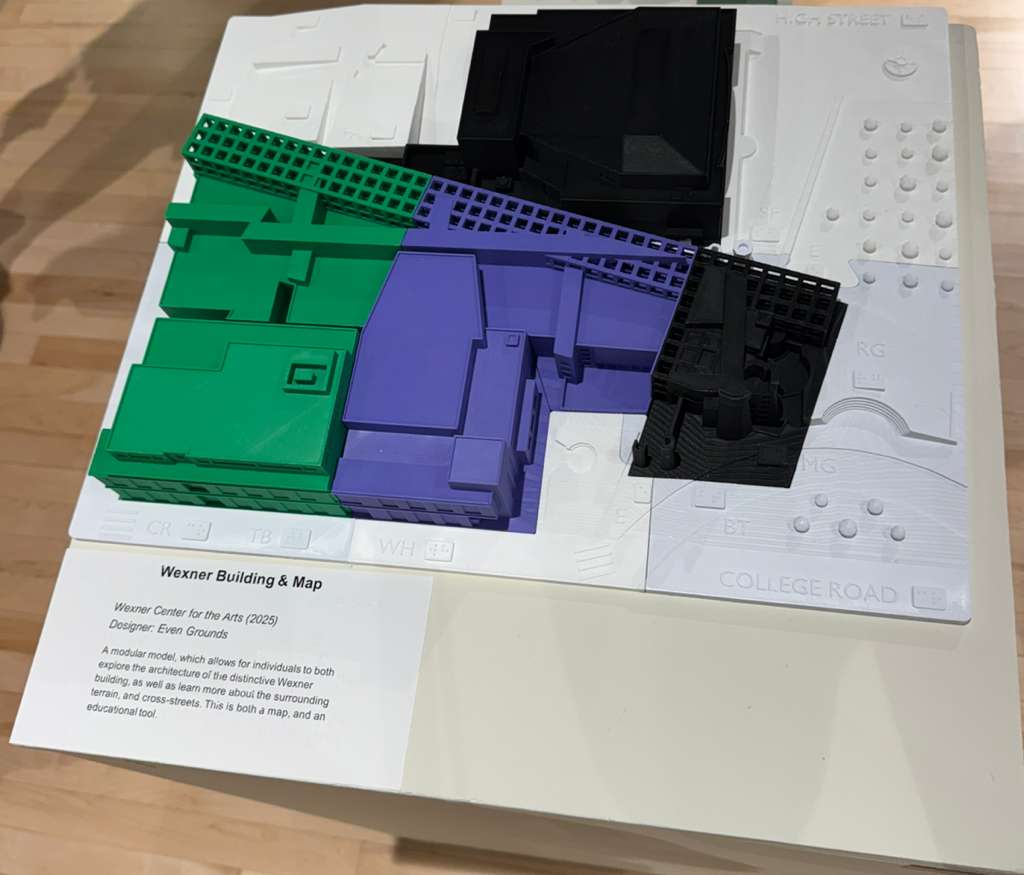
Leave a Comment

When 3D printing is preferrable to 2D tactile graphics

When supplying visual materials with braille books for the most part the use of tactile graphics is sufficient. However, there are many instances when providing 3D printed objects can enhance the understanding of the material. Even the Tactile Graphics Guidelines Mention 3-dimensional objects in the first sentence of the document: “Tactile graphics, in combination with 3-dimensional models, need to be introduced early in the process of learning braille.” Throughout this document 3-dimensional models are mentioned many times.

However, when it comes to practical implementation, rare are the books which are supplied with 3D objects. When I talked with many teachers of the visually impaired and with braille transcribers, their response was that while they are aware of the possibility of using 3D objects, but there is very little information on how to source these and what it really takes to get it produced.

In this post I will talk about what makes a good candidate for 3D printing and what is better supplied in 2D, or not at all. I will also look at the production process to help make the decision if 3D representation is indeed the right option for a particular object.

Leave a Comment

Exploring the World with Touch Mapper: 3D Printing Tactile Maps for the Visually Impaired

I am always searching for innovative solutions to enhance the independence of visually impaired individuals. One such solution that has captured my attention many years ago was Touch Mapper, a service that allows the printing of local maps based on addresses. These tactile maps, designed for blind and visually impaired people, show roads, buildings, and bodies of water, with data sourced from OpenStreetMap. With my new 3D printer, it was finally time to put it to a test.

2 Comments