Press "Enter" to skip to content

Tag: Sports

Erich Manser on the Resilience and Logistics of Blind Running

I would like to introduce you to my friend, and previous colleague from IBM, Erich Manser who is a competitive blind runner. Over the years I enjoyed hearing about his adventures, and when it comes to sports, I got much inspiration from him.

Erich runs in a 10k race guided by his adult daughter Ellie. Both smile big for the camera, Erich tips his hat and wears a bright yellow vest which reads Blind, while Ellie wears a similar vest that says Guide.

Erich is 53 and lives in Littleton, Massachusetts with his wife Lisa and their daughters Ellie and Grace. He currently works at Harvard University as part of their Digital Accessibility Services team, where he enjoys helping all Harvard schools & departments ensure their digital content and technologies are accessible and inclusive of all users. Erich enjoys running, and is proud to have run 25 marathons, including 15 Boston Marathons, as well as 3 Ironman triathlons.

2 Comments
Why do Blind Athletes Wear Blindfolds?

Most people view sports and athletics as a showcase of one’s strength against opponents, skills, and positional tactics. But to add diversity to this view, consider it from the perspective of an athlete with visually impairment. The usage of blindfolds by athletes is an intriguing and frequently misinterpreted component of adaptive sports. An interesting fact is that athletes participating in goalball and blind football wear blindfolds to ensure fairness. This makes the game more accessible where players with visibility or visual impairment both become the same.

Leave a Comment

Goalball Explained: Gameplay, Rules & Its Social Impact

Sports are all about working together, sharing power, and standing together. It transcends language and culture to bring people of all kinds. To most individuals who have blindness or visual impairment, goalball is more than just a sport. This unique sport is created for athletes who have disabilities and is a perfect example of the adaptability of sports. It helps foster confidence among the athletes, enhance communication skills, and improve spatial awareness. 

This article looks into goalball’s history, rules, techniques, and influence on its players, as well as explains its role in the efforts toward inclusion.

Leave a Comment

Blind people at the Paralympics

People at the Paralympics compete in 10 different categories, depending on their disability. Eight of the categories are physical disabilities, one is visual impairment, and one is intellectual disabilities. Depending on the individual sports, people with only certain disabilities can compete. This post will only contain resources related to blind and visually impaired people following the theme of the blog, but I would recommend getting to know the other sports as well. This topic has been covered in so many ways, so instead of creating yet another basic overview, it is intended to be more of a resource list for starters.

Leave a Comment

Running with a guide dog

I will never forget how much more freedom I experienced all of a sudden when I got my guide dog, Baldwin from guiding eyes for the Blind. That was approximately the time when Guiding Eyes started to train running guides. This means that a blind or visually impaired person can take up running as a sport and do it independently with a guide dog. The white cane is not for running, it is simply dangerous.

One could ask, why not just run with a regular guide dog? After all dogs enjoy running. This is why it is not possible: a guide dog by default is trained to recognize and avoid obstacles at a walking speed. When one would run with a guide dog, practically it would ask the dog to do something she has never been trained to do. It would be confusing for the dog and dangerous for the blind person. During the training program, Guiding Eyes does ask dog handlers not to run with their dogs while guiding, unless the dog has been specifically trained for that. By default, Guiding Eyes does not train running guides, but anybody can request one.

Leave a Comment

First Blind Man to Complete Race Across America

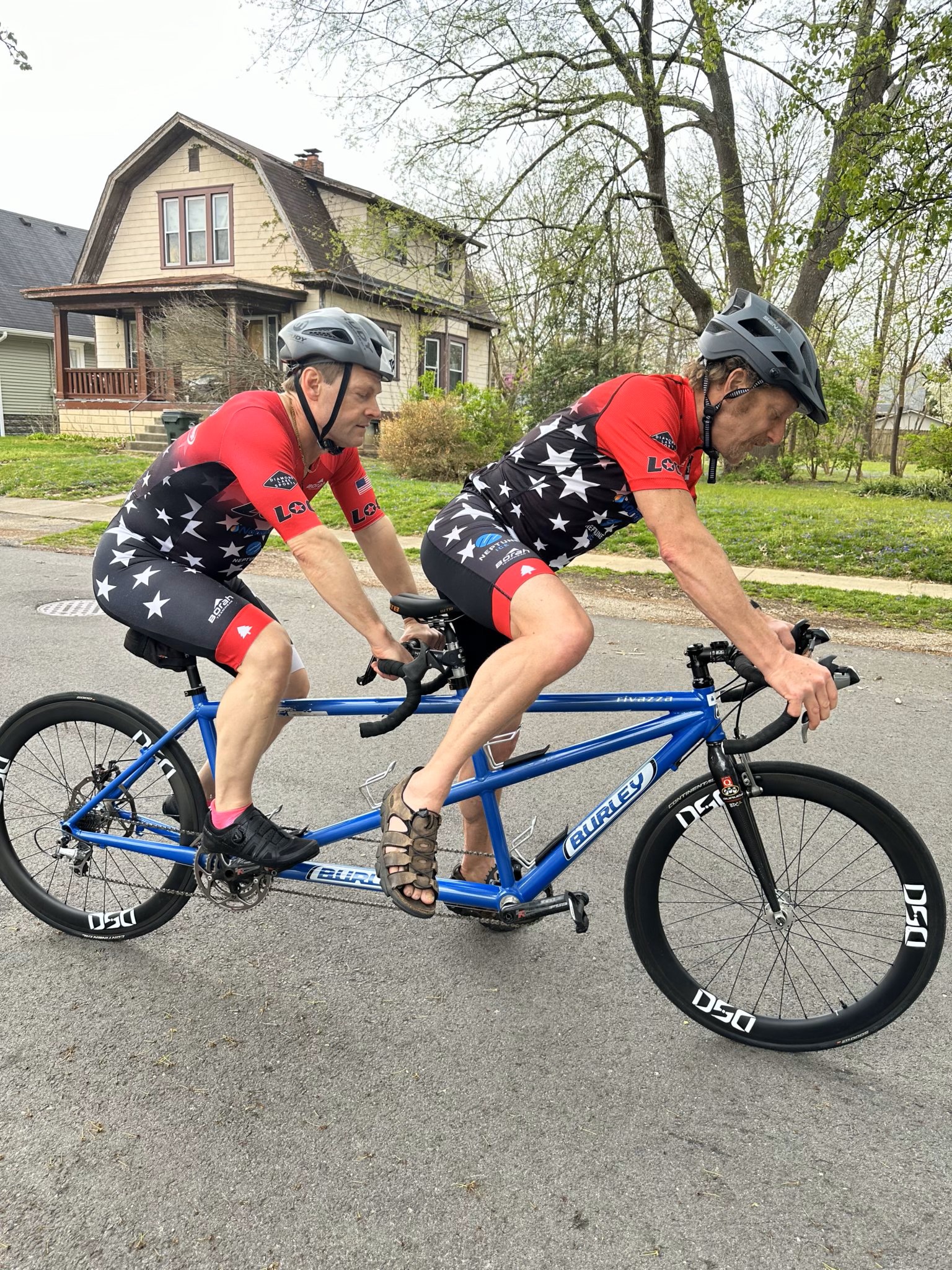
Dave Wilkinson, a blind 30-time marathon runner and Ironman, is planning nothing less in 2024 but to join the Race Across America bicycle race event. He will ride on a tandem bike with Jim Trout who has done this race several times before. They will ride 3000 miles in 12 days, across 12 states.

Dave and his tandem captain jim riding on a road

I have known of Dave over the years, and he was famous about testing the limits of what people can do, blind or sighted. But after a car crash in 2017, he needed to rethink his life and recover physically and mentally. And his way to cope was to do something even bigger, this is how he started training for Ironman and now for the Race Across America.

Dave explained to me that in his view, blindness should not hold him back from things which are traditionally thought of something that blind people are not active in. And this alone, if made him a high achiever that would already be impressive. But he has a much bigger vision in mind. He wants to provide motivation to other blind people to not be stuck inside the conventional ways. His dream is that there will be people who will do even better.

But of course there is much more to it. It is not just the courage to do it without vision. Many sports will have to be adopted to the situation, and preparation will also have its challenges. This is what makes it even more difficult, but not at all less impossible for blind people.

Leave a Comment