In an increasingly inclusive business landscape, the question of whether to add braille to business cards has become relevant for many professionals. While a significant portion of the global population won’t directly benefit from braille business cards, their importance extends beyond the visually impaired community. As businesses strive to stand out, resonate more deeply with their audience, and showcase corporate responsibility, braille cards serve as a symbol of commitment to inclusivity. But for those who read braille, it is not just a useful tool, but a lasting impression on you and your company.
Leave a CommentAuthor: Tom
I have been working in accessibility for the last 25 years. I have helped government agencies, corporations and non-profit organizations to become accessible. Over the years I taught over 20000 people about accessibility.
Recently I have come across a program in Ohio, which may fundamentally change what it means to create accessible travel and tourism in a state. Accessible Ohio has the potential to impact accessible experiences for people with disabilities by educating and consulting with companies who would like to make their services more accessible and inclusive. Of course, such services existed before, but here the difference is that it is taken to the state level, and actually funds accessibility consultations. As I understand, such an initiative is unique in the United States.
Leave a CommentRecently I came across a solution that could not only revolutionize restaurant payments, but would make it much more accessible to blind people as well. It is called CheckPlease. It is a simple app which allows you to pick a restaurant, order from the menu, and pay using your phone.
The end result, waiters will have to spend less time at your table, you can take your time to order, you don’t have to wait for your bill, and the restaurant can turn the tables much faster.
And the hidden benefit, it will make the process much more accessible for people with disabilities.
Leave a CommentI was curious if ChatGPT has any ways to help with travel planning that I couldn’t do with any other tools, so I put it to the test. I tried a few things where I had challenges previously, and overall it was able to help me in two specific ways: finding more efficient ways to get to places, and finding more accessible activities.
3 CommentsThe other day my friend was walking home from work using his white cane. All of a sudden he stepped into a hole, dropped 8 feet, and submerged into mud and water covering him all the way. It was the middle of the winter, the water was about 40 degrees Fahrenheit. He survived, due to nothing more than luck, when he touched a thick tube on which he could pull himself out of the freezing water. People saw the accident on the street and called the fire department, and they rescued him in half an hour.
Now you may wonder, how did it happen if he used his cane properly? Probably, he was. He was walking on a sidewalk where he had walked each day for years. He wouldn’t have thought to slow down and check for life-threatening hazards. But it was even worse. The hole was in front of a retirement home, also near a local school serving kids with special needs.
1 CommentIntroduction
Over the last few years, you may have noticed that many meetings and conference presentations start by people describing themselves. The idea is to make the meeting as inclusive for visually impaired people as possible. But is it for visually impaired people only? Does it make a meeting more inclusive? Is it mandatory? There are many more questions for which there are no guidelines, and often gets awkward to ask. I’ll try to answer some of these questions.
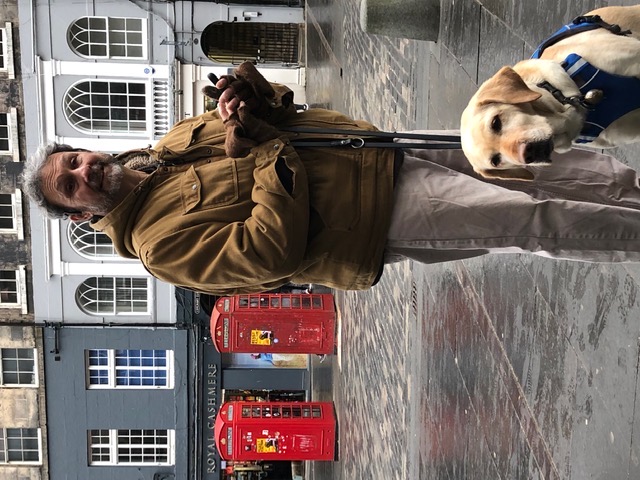
2 CommentsI recently read a post on a mailing list from Eric Caron, who explained the difficulties of traveling with a guide dog to Scotland. He wrote about the days of travel arrangements, paperwork, and expenses. I asked Eric if he would be willing to share his story with you. I have to say I had my fair share of difficulties to arrange trips with Baldwin, but nothing like Eric had to go through.
Eric lives in Brattleboro VT near Massachusetts and New Hampshire. This is about a 2 hour drive from Boston. He lives there with his wife Heidi, current guide dog Becky, retired guide Ryan, an African Grey Parrot and a Tuxedo cat.
A zoo is generally a visual experience, and by default there are many things blind people cannot enjoy. However, there are many ways zoos can be made an enjoyable experience for blind people. These are not specific to blind people, rather, things which can be enjoyed to all visitors.
Leave a CommentThe Visual Bucket List Foundation helps children who are losing their vision to create visual memories they can remember after they completely go blind. There are certain eye diseases which predictably result in the complete loss of vision. The foundation set out to provide children with such diseases to experience things which otherwise cannot be fully explained to blind people.

Often when discussing the experience of being blind, I find that different simulations are implemented to explain what it feels to be blind. Probably the most common is to put on a blindfold. While such exercises can have many different values, the only thing they don’t simulate is what it means to be blind. However, such activities do have value, they should just be used for what they are worth. In this article, I will show a few ideas and discuss how they can be useful and also what they don’t add to understanding blindness.
Leave a Comment