
Last week when I attended the National Braille Association conference, I was able to find some time to visit the Harriet Beecher Stowe House in Cincinnati. I admit, last time when I was in Cincinnati, I didn’t know about it, otherwise I would have put it on my list, though maybe it was at the time when they were doing the renovations. But in anyway, everything has a reason, and this time there was one more reason to visit, they have a few building replicas we made for them in collaboration with Clovernook, but more about this later.
By the time I figured out my final schedule and matched it with the opening hours, there were exactly two hours left for me to visit. I can’t thank her enough, the executive director, Christina Hartlieb immediately responded to my email and at a one week notice she generously made her time available to personally give me a tour of the house.
This house is famous about Harriet Beecher Stowe, at the time, Harriet Beecher living there from 1832 until her marriage in 1836. After that she still lived in Cincinnati, and her experience in town contributed to her most famous novel, Uncle Tom’s cabin. The book was translated to at least 75 languages, and my personal connection to it was that when I was a kid, my mom read it to me in Hungarian.
After Harriet left the house, the Beecher family still lived in it, later in the 1900’s it also functioned as a boarding house and a tavern, until at the end of the 1940’s it was opened to the public as a museum. Recently it has undergone a larger renovation and was opened again in 2024.
The house was renovated a few times, and recently I got a call from the Clovernook Center if we would be interested in making a 3D replica of the different versions of the house. Where the assignment was unique is that we didn’t have photos of the original building, so we had to work with drawings and historical data. We created a replica of the house as it looked in 1840, in 1940, and a replica of the current building from 2025.
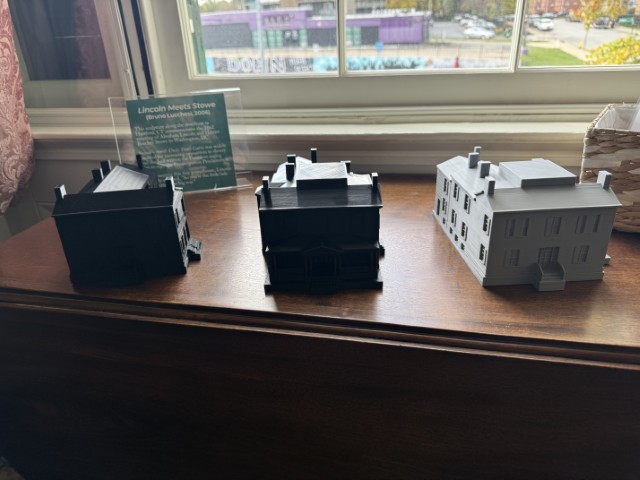
What was even more special is that when I attended the 2025 Ohio Museums Association conference, I found out that the team from the Harriet Beecher Stowe house would also be there and they will have a presentation about their work. It happened so that we did another presentation with Sam Foulkes from Clovernook, and we happened to have the first replica of the house which I was able to present to the team right after their presentation. Small world, or I’m just trying to be everywhere?
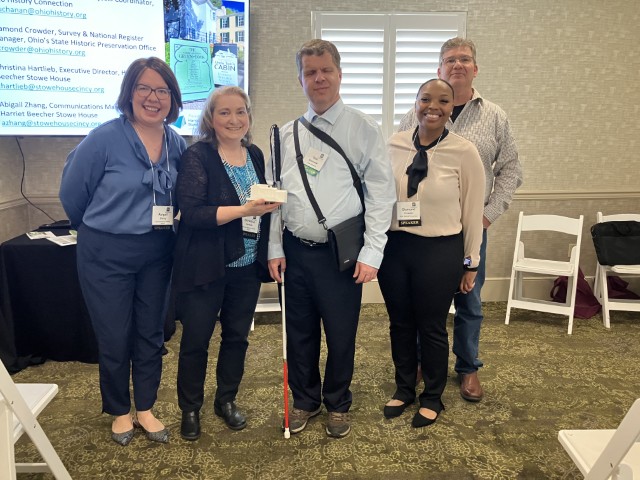
But back to the museum. When I arrived Susan and Katrina met me and before Christina also arrived they gave me a very thorough and interesting overview of the house and the era, you could just tell it wasn’t something for them to recite but they were passionate about everything. We happened to sit in the very same room where Harriet Beecher Stowe got married.
With Christina we toured the house, which is laid out around an interesting concept. One half of the house is restored to how it was in the 1840’s, and the other half of the house reflects the 1940’s. It is immediately obvious, the floor, the walls, buildings and objects tell you right away in which era you are.
It is one of those typical cases where I would say even if they did nothing for accessibility, there is so much to touch that I would right away qualify it as a tactile museum. But during the renovation and even today they put so much effort into making the house fully accessible. I already mentioned the replicas, which bring so much more meaning for blind visitors, but as I heard many people enjoyed seeing them. There is an exhibit upstairs which has a braille booklet describing it. Christina explained that they are working on more braille materials.
Also, as it is the case in historic homes with stairs, if you make the stairs accessible, you will have to majorly redo the house taking out the original construction. Thus, during the last construction, they built a ramp around the house so that people can go in with a wheelchair, but since the upper floor is not accessible, Christina recorded a tour of upstairs which she can show to people who are not able to use the stairs.
I always talk about accessibility: that’s my job and passion, but I really wanted to bring you a different perspective. I asked Christina to explain to me why did they decide to make the house accessible, why was it important to them. Accessibility is important, of course, but this is a major undertaking for such a small historic site. Here is what she had to say:
“The Harriet Beecher Stowe House is a historic site that interprets both the 19th century ideals of abolition and the 20th century period, when it was an African American boarding house, community gathering space, and tavern. As a place that focuses on equity and community, we wanted to create the best visitor experience for all our guests. That was our starting point to create an accessible museum tour. Our staff created some of the inclusion designs. For others, we partnered with different groups, like Clovernook and Even Grounds, to bring the ideas to life. Some of our features include 3D models and items that can be touched. We have a video version of the upstairs portion of the tour for visitors who cannot go up the stairs. We also have a 2-page written introduction to the tour in several languages and a sensory kit that kids can use while here. Twice yearly we host Deaf Day, which provides ASL interpreters to accompany our regular tour guides. Being able to use all of your senses are important. So one exhibit has a scent feature, and we plan to add a sound feature to another exhibit soon. Economic accessibility is also important to us. Using the Museums for All program and our local public library, visitors can obtain free or very low-cost tickets. Everyone is appreciative of the ways we have improved the tour experience and encouraged broader participation.”
As I was preparing this post something else came to mind that I wanted to share with you. For many years I have been struggling with using photos, and it seems like I always get it wrong. People keep asking me to have more pictures, and let’s face it things spread better with more visual content. But here is my problem. When I take my own photos, as I am completely blind, I can use certain artificial intelligence to focus better, but it is not good photography. But when I ask my guide to take pictures for me, I always feel awkward. So there is a person who generously gave up their time to show the museum for me, not to mention that often it is difficult to fit things into my schedule so they are always so kind to still make it happen for me. And then I worry about the best photos I can later post to Instagram. Ok, probably it is good for the organization to have more publicity too, but until I can figure out how to quickly and efficiently get good pictures of my visit, I think I am there to learn, to enjoy the experience and take it all in, not to worry about what will go to social media. It gets even harder as I am running my business because I cannot neglect marketing, so this time I asked Christina to take a picture of the buildings we made for them. But this was it, now I’m a little sorry I didn’t at least try to take a few more pictures, but as I said, I never get it right, but the experience was unforgettable.
I highly recommend this museum to anybody, but particularly to blind people because there is so much to feel there, and I didn’t give it away, experience it for yourself. They even have some amazing other sensory experiences that I really enjoyed. For now let me just say I is an innovative use of smell.
If you visit this museum, leave a comment and tell me about your experience.
And if you would like to read more about my travels and museum reviews, sign up for my newsletter.
No comments! Be the first commenter?