
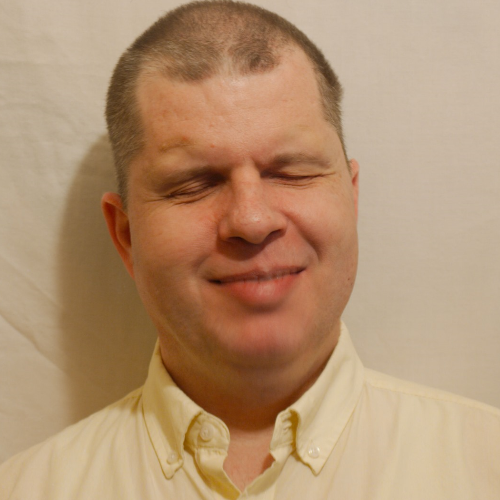
I would like to introduce you to my friend, and previous colleague from IBM, Erich Manser who is a competitive blind runner. Over the years I enjoyed hearing about his adventures, and when it comes to sports, I got much inspiration from him.

Erich is 53 and lives in Littleton, Massachusetts with his wife Lisa and their daughters Ellie and Grace. He currently works at Harvard University as part of their Digital Accessibility Services team, where he enjoys helping all Harvard schools & departments ensure their digital content and technologies are accessible and inclusive of all users. Erich enjoys running, and is proud to have run 25 marathons, including 15 Boston Marathons, as well as 3 Ironman triathlons.
The following is an interview I did with Erich, and since there are a few interesting interviews with him already, I did not ask him about much of the basics, rather, things that sounded interesting to me or I thought could be interested for my readers, but couldn’t find it covered in other interviews.
Tom: What does running mean to you on a personal level? Beyond the fitness and the finish lines, why are you so dedicated to such a demanding discipline?
Erich: There are a few reasons. First, I began running shortly after college, at a time in my life when some of my personal & dietary habits weren’t exactly healthy. Back in school, I was a collegiate swimmer, and could get away with eating a lot or partying, because we were doing the work to offset that. After leaving school, however, things quickly caught up with me, and before long my weight ballooned by more than 80 pounds! So, I primarily took up running for weight loss.
Then, with time, the countless benefits that come with exercise simply became so much a part of my life, that I could no longer imagine it without some sort of fitness routine. I’m at a point now, where if I miss even one day, I feel out of sorts. While the perks of running have been too numerous to mention, I consider a key benefit for me personally to be that the endorphins and energy boost that running provides have become an integral part of my coping strategy for dealing with vision loss.
Tom: When you are looking for a guide to partner with, what is the single most important factor you look for?
Erich: A beautiful thing about guide runners is that the types of people who would volunteer to help others in that way generally have the traits I might look for already. Things like kindness, compassion or a willingness to learn.
Once a connection is made, it becomes a matter of learning each other’s preferences and style, and ‘finding your rhythm’ as a team running together. Social media can be great for enabling those initial connections, too, with sites like United in Stride or a Facebook group for Visually Impaired and Blind Athletes and Guides.
Tom: I know independence is a core value for you. However, competing at your level requires working closely with a guide. How does that partnership enhance your independence rather than diminish it? In your mind, does it ultimately add to your freedom or take something away?
Erich: It’s an interesting question, because I’ve thought quite a bit over the years about the stark differences between the feelings of liberation you get while out on the race course giving your all, and then contrasting that with how limiting it can feel when navigating somewhere else like the grocery store.
In my opinion, it’s a sharp example of how my disability is not the problem, but rather, that things like products, buildings or experiences are often not designed with diverse needs in mind. In most cases, the smallest adaptations can make all the difference for enabling the equality and independence of others.
Tom: Given the advancements in technology and your own experience, do you feel a drive to run completely independently/alone, or does the “team” aspect of guided running matter more to you?
Erich: This question reminds me of another that I’ve been asked from time to time, about whether, if given the choice, I’d wish to have my full sight restored. To me, it seems like a highly personalized question, and like the answer would certainly differ from one blind person to the next.
In my case, I believe I’d accept whatever medical or technological path might restore my vision. I feel like my visual memories & habits are still pretty recent, whereas each new level of vision loss feels like a steep adjustment as I experience it.
At the same time, it is my vision loss which has allowed me to make wonderful connections with so many kind & caring people. I’m not sure I would have had that same level of deeply meaningful connections, in quite the same way, without the disability.
So, to answer the question, while I would personally welcome a technology that could enable a blind person to safely run solo, it would really be for the sheer benefits of autonomy and having more options. At the end of the day, though, there will never be a technology to replace the genuine kindness of others, and I believe I have & will continue to gain far more benefit from that.
Tom: How did your approach to sports evolve as your vision changed? Looking back at the challenges, is there a perspective or a strength you’ve gained from competing as a blind athlete that you think you might never have discovered as a sighted person?
Erich: My vision loss journey includes nearly 30 years of time between when I was diagnosed with retinitis pigmentosa (RP), which causes progressive blindness, and when I finally accepted the label of having a disability. For me, it’s been a truly gradual process over a prolonged period.
Similarly, it was also many years before I started to think of myself athletically as someone with a disability. When I was younger, I didn’t see my visual impairment as anything more challenging than it would be for anyone who needed glasses, and I certainly didn’t think of myself as disabled. I was just an athlete who couldn’t see very well, participating in sports with all my able-bodied peers.
And while I did have some talent, even earning a collegiate swimming scholarship, I never quite got to where I was consistently “the fastest” or “the best” on any of my teams. It wasn’t until years later that I could finally begin to see that my early experiences in sports had equipped me with the attitude, perseverance and mental toughness which has allowed me to remain competitive as my vision has continued to decline.
Tom: What goes through your mind when you run a marathon? I would imagine that it could be much more interesting when you can see your surroundings. Doesn’t it get monotonous?
Erich: It’s funny you should ask, because this question brings up for me one of my fondest memories of my racing experience. Early on in running, even before I had “officially” started using sighted guides (my earliest races were done “shadowing” other runners, who had no idea they were guiding me), it occurred to me that, here I was, running some of the most scenic marathon courses around, like on Cape Cod or Newport, Rhode Island, and basically missing all the gorgeous natural & seaside views. At the time, my “method”, with only a small, central field of vision, was to focus on the back of the person running in front of me, and follow them closely. I wasn’t exactly looking around very much.
The fond memory I have comes from my very first triathlon, which I did as part of a larger group of blind and visually impaired athletes competing in New York City, when I first decided to try that sport. At that event, which also gave my first experience with guided racing, some of us met our guides for the first time in Central Park the day before the race, in order to try out tandem cycling. For me, it had been several years since I had been on a bike, which I had basically given up riding when I had gotten my learner’s permit to drive a car at 16. So, after many years of not riding bikes, I suddenly found myself on the back of a tandem bicycle, whizzing along through crowded Central park in New York City, and not having to look out for what was ahead of me. It felt so liberating to be able to soak in that experience, fully enjoying the exhilaration, without the anxiety of possibly crashing or hitting someone. I credit that experience as pivotal in my decision to move over completely to guided racing.
Tom: Can you share a moment from a race where things didn’t go as planned, and how you navigated that frustration in the moment?
Erich: There have been plenty of races that didn’t go exactly according to plan. In fact, I’d go so far as to say it’s truly a rare thing when any race goes precisely as we’d hoped it would. I think it’s one of my earliest lessons from racing, the knowledge that, once you’ve done all this training, for months & months, so how do you deal with it if things clearly aren’t going your way on race day? It’s important to consider your A, B and C outcomes in advance, so that you don’t completely decide to ‘throw in the towel’ if Plan A isn’t working out.
For this question, I immediately think of two specific races, the 2013 Boston Marathon, and the 2018 Ironman World Championships in Kona, Hawaii. It’s an understatement to say that neither of those races went according to my personal plans, but for very different reasons.
At the Boston Marathon in 2013, the year of the bombings, my guide Robin and I were beyond fortunate to have finished the race nearly 10 minutes ahead of the first blast. We had proceeded down the finishing chute, and were in the process of making our way back toward the areas where both explosions happened. At that point in my running career, that day’s race had been my slowest marathon yet, a fact that had me feeling pretty bothered. After the devastating events of the day, though, with the profound trauma and loss experienced by so many, it became clear just how blessed we had been, and just how divinely adequate my run that day had been.
Another race which proved incredibly humbling for me was the 2018 Kona Ironman World Championships . Prior to Kona, I had done two previous Ironman races in Florida and in Maryland, each consisting of a 2.4 mile swim, 112 mile bike ride and a full 26.2 mile marathon. In each of the earlier races, I had achieved the fastest time by anyone visually impaired racing guided, so in both cases, things had gone as close to perfectly as possible. Then, when I made it to Kona, which is like the Super Bowl of triathlons, I fooled myself in to believing that the strongest performances automatically happen on the biggest stages, and when reality took over and that wasn’t proving to be the case, finding the fortitude to continue despite my hopes being dashed took a lot. It ended up being quite a long day, but Kona was still a magnificent family vacation, with some incredible memories to last a lifetime.
Tom: How does technology shift your approach to races and training? I’m interested not just in what you use on race day (like Aira or specialized wearables), but how tech influences your preparation and general training routine.
Erich: There’s really not a lot of technology I’ll typically use during a race. In my case, my decision to work with sighted assistance largely replaces the need for tech, as it’s the sighted guide who ends up alerting me to water stops, sharing about pace, mile markers, etc. From a performance standpoint, it’s just been more efficient and has cut down on time if I don’t need to personally bother with technology that is often inaccessible.
In training, however, I often have no choice but to find ways of working with that same inaccessible tech, in order to remain competitive and optimize my training. Over time, apps and devices seem to come and go with more or less promise, but there really hasn’t been a clear front-runner in fitness tech who has led with accessibility. This has produced a considerable disconnect in how I train vs. how I access data on race day.
In an ideal world, the development of some comprehensive solution that might help minimize this disconnect could be really exciting. In the case of non-visual racing, it would seemingly need to be something full body and multi modal, in order to provide adequate feedback and a complete picture, to allow someone who is blind to navigate safely at higher speeds among crowds, traffic, etc. I remain convinced that this is a fertile and underexplored territory for fitness tech manufacturers.
Tom: What you’ve achieved over the last few decades is extraordinary, and frankly, a level of athleticism most people—sighted or not—will never reach. What is the one thing you want blind kids and youth to take away from your experience?
Erich: You’re very kind, and I appreciate the kind words. The number one thing I’d want blind youth to know is that, no matter what they’re into or interested in, someone out there is likely doing it while blind. My earliest days of racing, back when I was using strangers as guides, felt very isolating, and the struggles I was feeling really felt like mine alone. As I branched out and met others in adaptive sports, it became clear that nothing could have been further from the truth. There are so many blind and visually impaired folks out there doing incredible things. Whatever it is that any blind child might want to try, I assure you, there’s someone out there who can offer their experience, tips or suggestions, and help you get started trying it. I encourage them to leverage the power of our blind community, get outside your comfort zone, and go ahead and get started!
Tom: Many parents of blind children want their kids to succeed but are paralyzed by the fear of them getting hurt. What is your message to those parents who want to protect their children, but might be inadvertently limiting them?
Erich: First, what I’d say, is that I completely understand the urge to protect our children, as a parent now myself. I was just 5 years old when my family learned that I have a condition that gradually causes blindness, and it wasn’t until years later that I came to appreciate the remarkable wisdom my Mother showed following my diagnosis.
When I was diagnosed, all of the experts were telling my Mom not to let me do things, like ride bikes or climb trees. What she saw at that time, though, was a kid who could mostly see, but who struggled in certain situations, like dark or dim lighting. Rather than restricting me, my Mom encouraged me to be active, but to also be smart about it, by adjusting how I did things in order to make them safe and comfortable for myself.
To this day, I feel forever grateful to my Mom for her incredible foresight, and for giving me wings instead of limits. I know she is the reason I’ve gone on to do so much of what I’ve been able to do.
Tom: You’ve conquered the Ironman, set world records, and pushed the boundaries of assistive tech. What is the next “frontier” for you? Is there a race, a technology, or a project that you still feel a burning need to tackle?
Erich: At this point in my life, I wouldn’t say there’s a particular activity that I feel a real need to try. While I still enjoy running immensely, I’ve recently begun embracing the liberation of not having a specific race for which to train, and this year’s Boston Marathon will be the first one I haven’t run in quite a while.
Living in New England, though, I’m finding that with the time I’ve gained by not training for Boston, I’d like to give adaptive skiing a try. It’s been 40 years since I downhill skied, and I’ve never done it guided, so I’m excited about heading up to Vermont this February for some adaptive ski lessons with the Vermont Adaptive Ski program.
Tom: Erich, thank you for sharing all the great details about your experience, I am sure many of us learned something new from you. Enjoy skiing in Vermont, and when you prepare for an other great adventure, don’t forget to let me know.
No comments! Be the first commenter?